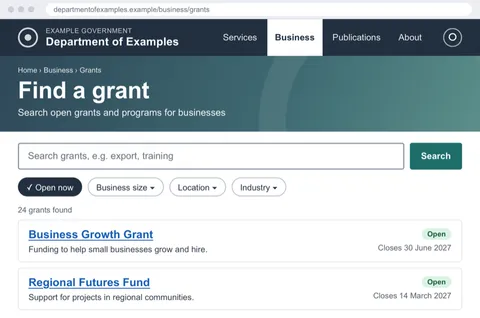
Grants finder
Some friction. No redesign decision coming.
When time and budget are tight, a small amount of user research can still change a decision, as long as you choose it well.

I have a confession. The first time someone suggested we test a product with real customers, I looked at them and asked, “Why?”
I came up in digital marketing. The thinking back then was that you could get everything you needed to know about your audience from Google Analytics.
Of course, my thinking has changed since then.
But I still hear that “why” in a lot of meetings. Sometimes it’s that blunt.
More often it’s quieter and more subtle, especially now, when budgets and timelines are tight. It tends to sound like this:
“The executive really likes this design.”
“This should definitely go on the homepage.”
“I think users will find it intuitive.”
“We don’t really have time for testing.”
Getting time and budget for discovery is hard. But building products is getting faster and cheaper. If anything, that means we need to put more energy into working out what to build, and whether it works.
Here are the bones of good research, for people fitting it in around the rest of their jobs. It comes down to three choices that make a small amount of research count: what you test, who you test with, and who’s in the room when you do.
Choose what to test.
Bang-for-buck research isn’t about collecting the most evidence. It’s about collecting the most useful evidence, at the right time, to support a decision.
When we are thinking about how to make the most of our research/testing capacity when we have it, we start with ensuring we’re focussing in the right area.
Our rough mental model has three parts: uncertainty, user impact, and an upcoming decision.
You want to learn something new, about something consequential, that will change what you do next.
Miss one and you can end up in some interesting territory.
If there’s uncertainty and impact but no one will act on what you find, that’s potentially vanity research. It might be useful one day, but not when budgets and time are tight.
If there’s a decision coming about something with a big impact on users, but you’ve already got solid evidence, or there’s a clear best-practice pattern that suits your audience, it might be research theatre.
And when there’s lots of uncertainty and a deadline, but very little consequence for users? Welcome to the great button-colour debate.
The sweet spot is where all three meet: something important, consequential, and still time to act.
Of course, this is an exaggeration. Foundational discovery and deliberate validation both have their place. But if you only had one week to do some testing? I’d recommend you don’t start in either of those places.
Imagine you’ve got one week of research capacity, a tiny budget, and three teams asking for help.
Some friction. No redesign decision coming.
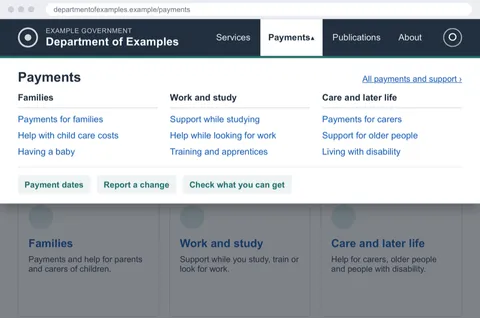
Navigation sign-off next week. Approach untested.
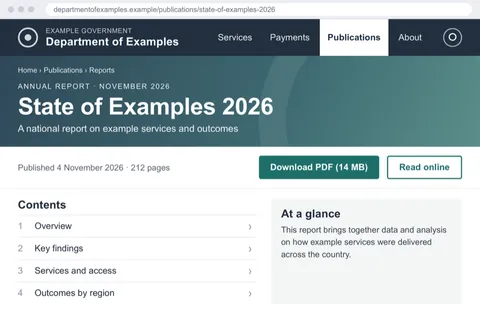
Needs a reusable template. Readers with different needs.
When I put this to the room at DrupalSouth, B got the most votes. That’s where I’d probably start too. The navigation goes to sign-off next week, and if we find something important next month, it may be too late.
But a lot of people also picked C, and that surprised me. Maybe it’s the pull of a high-profile product. A major public report gets noticed, there’s real uncertainty about what its readers need, and a template that gets reused for years is worth getting right.
And I’d love to test A. Nobody has a redesign decision coming, so on paper it sits outside the sweet spot. But a few sessions showing exactly where people get stuck can be the evidence you need to get funding to fix it.
Sometimes the research is what puts the decision on the table.
It’s important to flag that none of these answers is actually wrong. What matters is knowing what you’re getting from the research, and being able to say so to whoever is paying for it.
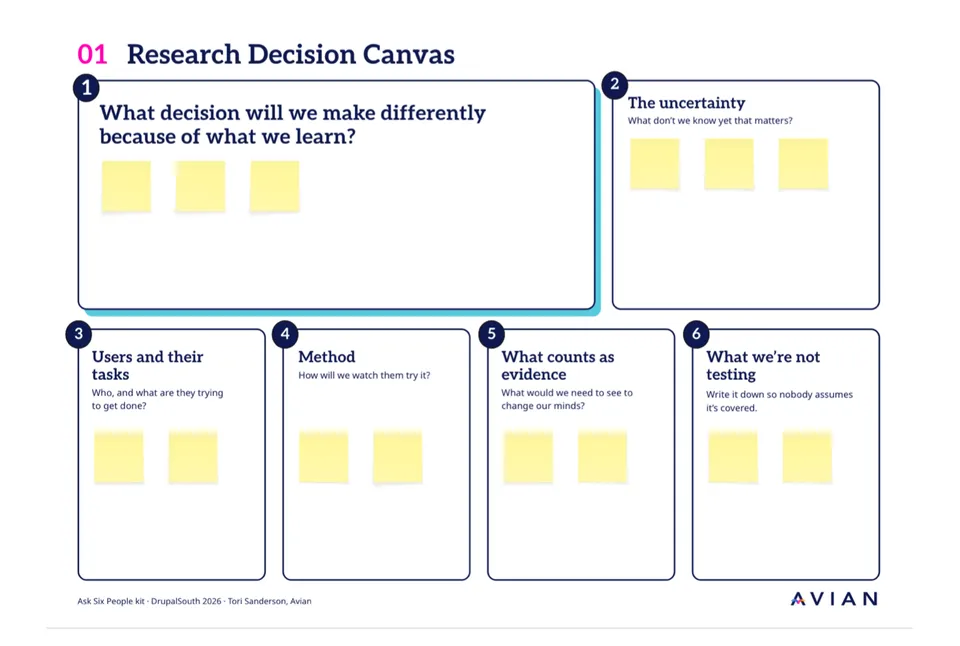
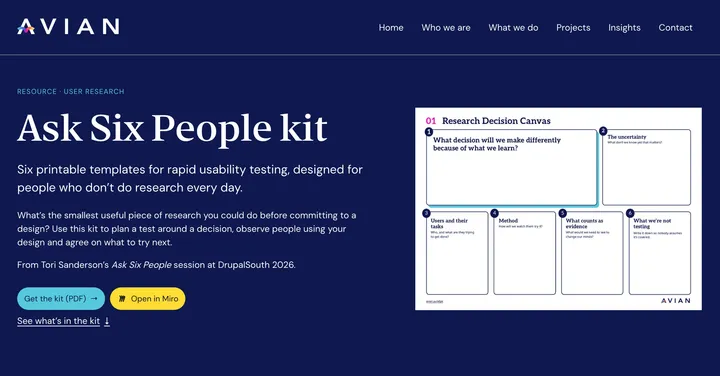
Before we book anyone in for sessions, we pull together a Research Decision Canvas: a one-page plan, that helps us design research that actually gives us the evidence we’re looking for.
The first box asks what decision we’ll make differently because of what we learn. Then come the uncertainty, the users and their tasks, the method, what counts as evidence, and what we’re not testing.
If the honest answer to that first question is “probably nothing”, maybe rethink the study.
Find the right people.
Once you know what you need to learn, the next question is who can actually help you learn it.
It’s always tempting to recruit six human beings who happen to have a free calendar. Paid research panels make that easy. They cost money, but they’re simple to run. They just don’t always give you the right people.
Here are two scenarios from Avian projects this year. For each one, who would you recruit: A or B?
A truck driver who uses the finder every week.
A caravan owner who’s never weighed their rig.
A real reason to do the task, and fresh eyes.
A weighbridge weighs vehicles and trailers. I’d choose B. They’ve got a real reason to do the task, and they bring fresh eyes.
We had a great discussion about this trade-off in the room at Drupal South. Some suggestions from the audience made the great point that if you don’t test with the high context user (A), you risk making the product worse for them through your changes.
This is true; there are times A is the better choice, like when you’re changing something and want to make sure you aren’t making it harder for regular users. But generally, if it works for someone with low context, it will work for someone with high context.
Someone who prepares meat export paperwork for a living.
Can tell us if it works for the job.
Someone who’s never worked in exporting.
We went with A for this one. B might help us find jargon, but they can’t tell us whether the guidance works for someone doing the job. We might do some plain English testing with the general public later on. When time and resources are tight, though, your primary audience is a good place to start.
So sometimes the general public is right, and sometimes you need a specialist. Which brings us to the most annoying phrase in user research: it depends.
When we’re choosing whether we need high or low context users, we ask three questions.
The last one is easy to skip. Someone who already knows the design, or the answer, can’t show you what it’s like to meet it for the first time.
You don’t necessarily need to start with a recruitment agency either. You might use an opt-in customer network, a service channel, or an industry association that’s willing to circulate an invitation. Then screen people to make sure they’re relevant. Specialist users still take time to find, and appropriate incentives can matter.
Where to find them
Involving our stakeholders.
How to run the session itself is a topic for another day, and there’s a moderator cheat sheet in the kit for that. Here I want to focus on who else is in the room.
I think we should do this much more often: invite the people making the decisions to watch. It can make an enormous difference.
As researchers, we’re often reluctant to do this, and there are some good reasons. Running a session while people watch can feel like attempting a tricky parallel park with an audience.
We’ve probably all seen and experienced some less than ideal behaviour from observers. But these are all solvable with a really clear brief, explicit tasking and some good expectation setting.
Here are the behaviours we see most often when bringing friends into our research sessions:
The Helper asks, “They’re stuck. Should we help?” Lovely instinct. Just maybe not right now.
The Context Provider explains, “Well, that button is there because of a platform migration in 2017…” Very useful context, maybe, but not for the participant. They don’t need to care. Save it for the debrief.
The Fast Fixer has opened a ticket halfway through the first task. They know the fix and they’re keen to help. Of the three, they can seem the most helpful and be the most dangerous. I love the energy, but it’s important to finish the research before you start fixing things.
They all mean well. But they can make the session quite hard in the moment, and if you’ve been there, the temptation is to keep observers out altogether.
That isn’t the only option. You can give them a job.
Brief them first. We’re testing the design, not the participant, and not the moderator. Then one person moderates, and everyone else watches and takes notes. The clearer the job is, the better.
The more explicit you can make the briefing for observers, the better. Don’t just ask them to take notes, tell them what kind of notes you want and show them how important that is.
On a shared board, we separate what we saw from what we think it means. While observers are watching, their job is the first column.
What we think it means goes in its own column.
“The participant missed the arrow” is an observation. “Our navigation might be hard to recognise” is an interpretation. Both are useful. But an interpretation is still a maybe.
After each session, spend five minutes together. What stood out? What repeated? What do we want to check next?
On a recent federal government project, client colleagues joined the observation and captured notes in Miro. That meant the learning happened together, not three weeks later when the report arrived.
It’s also how you stop the Fast Fixer. Nobody fixes anything after session one. Until you look across the sessions, you can’t know whether you’re fixing an arrow or missing a bigger opportunity.
We’ve put the practical bits into a free Ask Six People kit: six printable templates, also available as a Miro board.
Remember those meetings at the start? “I think users will find it intuitive.”
Next time you hear that in a meeting, also ask: what’s the smallest useful piece of research we could do before we commit?
Because if we’re going to spend forty-five minutes arguing about what users will do, we could just ask one.